
Deck Staining vs. Painting: Why We Always Recommend Staining


Deck staining vs painting...it's a question we get more often than you'd think. We've been called in by homeowners to assess their deck and we've seen the damage firsthand. It's almost always the same form of damage—peeling, blistering paint with moisture trapped underneath the failing paint, leading to rot.
After over 15 years in the painting industry, our answer to this question has become pretty one-sided. We'll break down what actually happens when you paint a deck, bust a few common myths, and give you our honest professional opinion.
Why Paint & Decks Don't Mix
Wood is hygroscopic, meaning it attracts and retains moisture from its surroundings. This creates a huge problem when you paint over it, as dried paint creates a film that effectively seals the wood off. Wait, that doesn't sound so bad, right? Well, you have to consider that moisture will still get in through the ends of boards, the underside, and any gaps between planks—it just can't get back out. That trapped moisture is what causes rot, blistering, and paint failure.
Paint and moisture don't mix, and decks see a lot of moisture. Unlike a wall, deck boards are horizontal, which means rain and snow sit directly on the surface rather than running off. That pooling water puts constant pressure on the paint film and can cause it to fail far sooner than you'd expect.
And it just gets worse with time. Every small chip or scratch in the paint—like from dragging a patio chair or just regular foot traffic—becomes an entry point for moisture. Once water gets under the film, it has nowhere to go. In Ontario's winters, that trapped moisture freezes, expands, and forces the crack wider. By spring, what started as a small scrape has become a patch of peeling paint and wet wood underneath.

Common Misconceptions About Deck Paint
Since we've been in the painting industry for so long, we've heard a lot of common myths surrounding painting a deck. It's understandable, as you would think paint would create a nice, thick, UV-resistant layer to protect your wood. Unfortunately, it's a little more nuanced than that. Let's break it down.
Deck painting can last a long time
When you look online for information regarding deck painting, it can be difficult finding a concrete answer on whether or not deck painting lasts. Some articles say that with proper prep, deck painting can last upwards of 10 years. While that may be true for those who live in sunny climates with no snow, it simply isn't true for Ontario homeowners.
Ontario winters are prone to freeze-thaw cycles, which makes moisture contract and expand. Some homeowners shovel their decks over winter which can cause physical damage to the paint, which makes moisture easier to get in. We also have very rainy periods during the springtime. This can be tough on painted surfaces, particularly decks.
From our experience seeing painted decks and painting them ourselves, you have about 2 to 5 years before your deck begins to fail in Ontario, erring on the shorter side.
Paint is more protective than stain
While paint does create a hard, protective film, it still does more harm than good in our Ontario climate.
Paint does offer better UV protection than most stains—especially semi-transparent ones—and provides better resistance against surface abrasions and physical wear. We'll give it that. However, because moisture gets sealed in and eventually causes paint failure, we wouldn't say paint is more protective than stain overall.
"I've already painted my deck, I have to paint it again"
A very understandable but common misconception. You can actually stain a deck that has been painted before.
If you're wanting to use a clear or semi-transparent stain on it afterwards, ensure the wood is still in good condition before proceeding. Clear and semi-transparent stains showcase much more of the wood than paint and solid stain do. It will require significant prep work before the stain can go on. This includes power washing or washing and sanding it down to the bare wood.
If the wood isn't in as good of a condition, a solid stain would be the better choice. Roughly the same amount of prep work will be needed, which includes cleaning the deck and sanding it down to get rid of the old paint. For a quality paint job and allowing the wood to properly breathe, we would highly recommend sanding down the old finish completely before applying a solid stain. However, if in a pinch, you can actually use solid stain directly over latex-based paint—just make sure you first sand down any areas that are peeling, flaking or failing in any way.
Painting is cheaper than staining
People often hear 'deck staining' and think it's an expensive process, whereas painting may be the budget option. However, it's actually the opposite.
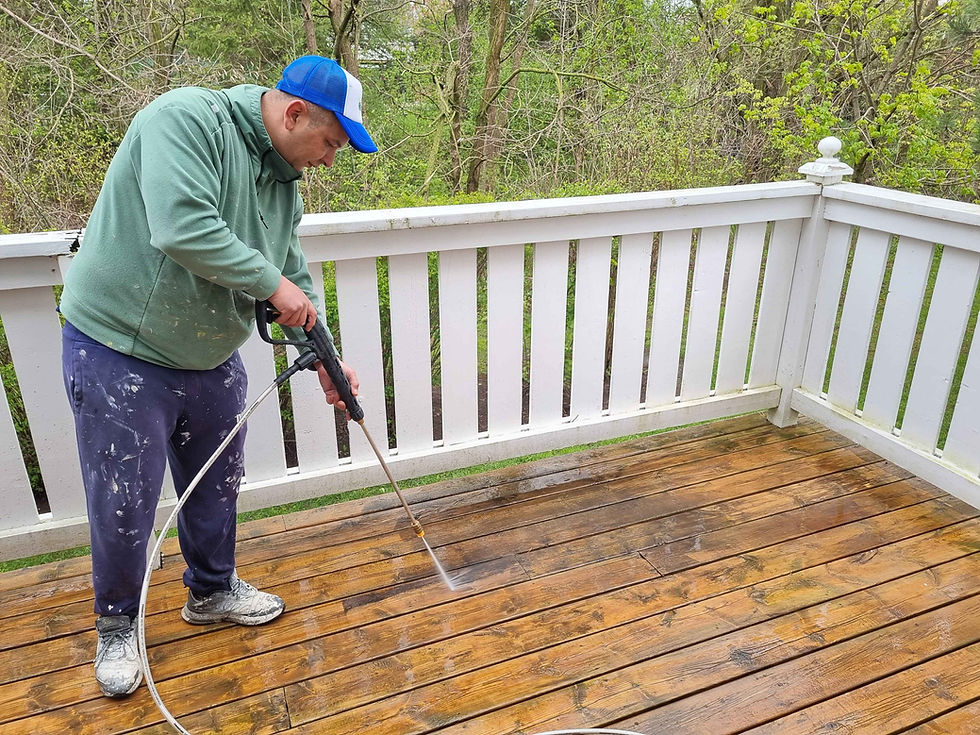
With painting, you need thorough prep done to the deck beforehand, and a lot more materials. To paint a deck with the proper prep, you would need to:
Clean the deck thoroughly: Power wash or scrub with a deck cleaner and brush to remove dirt, mildew, and any previous peeling or flaking paint. The deck needs to be completely bone dry before moving on, usually 48 or more hours minimum (the process speeds up if it's particularly hot and not humid).
Inspect and repair: Check for soft spots, rot, popped nails, loose boards and splinters. Replace any damaged boards and hammer down or replace any of the fasteners. You cannot paint over these structural issues.
Sand the entire surface: For better adhesion and smooths out any rough patches, splinters or areas where the previous paint has failed. On a full deck, this is a significant amount of work.
Apply wood preservative (if using): Wood preservative is applied to bare wood and it's especially important for older, weathered decks.
Apply primer: A quality exterior primer will be needed to ensure the paint adheres properly and has some resistance against moisture. Without it, your deck will fail much sooner.
Apply paint: At least two coats of paint with plenty of drying time between each one.
It's definitely a massive laundry list of steps just to paint a deck. Unfortunately, people go through all of this just to have their deck fail—it's not a matter of 'if', it's a matter of 'when'. With the amount of products and all the prep you need to do beforehand, repainting a deck every couple of years is very costly compared to staining.
Comparatively, the staining process is interestingly much more lightweight.
Clean the deck thoroughly: Power wash or scrub with a deck cleaner and brush to remove dirt, mildew, and any previous stain that may be leftover. Ensure that your deck is bone dry before you begin staining.
Inspect and repair: Same as painting—check for soft spots, rot, popped nails, loose boards and splinters. Replace any damaged boards and hammer down or replace any of the fasteners. You cannot stain over these structural issues.
Sanding: The deck should be sanded down to remove any old stain, debris and provide a fresh, clean surface for the new stain. While you can apply fresh stain directly over an existing coat with some minor sanding, we highly recommend sanding down the deck first for the best possible finish and adhesion.
Apply stain: One or two coats depending on the product and opacity.
For staining most decks, it's a matter of giving it a power wash, letting it dry, doing some sanding and applying the stain every couple of years. This is much cheaper and less labor intensive than painting a deck, as you will have to redo it less frequently and it requires less labor and materials.
Why Staining is the Better Choice For Your Deck
So, why does staining work where paint doesn't? It comes down to how the two products interact with wood on a fundamental level. Here's what makes staining the better choice for your deck.
How stain works:
Stain penetrates into the wood fibres rather than a film sitting on top, offering unique preservation and protection
Allows the wood to breathe and release moisture naturally
Expands and contracts with the wood through temperature changes
What this means:
No moisture gets trapped underneath, which is the primary cause of wood rot and paint failure
When clear and semi-transparent stains wear down, they tend to fade out naturally rather than peeling and lifting and becoming an eyesore
There is less prep work involved in re-staining
Ontario-specific advantages:
Handles freeze-thaw cycles far better than paint, as there is nothing to crack and lift when water expands
Breathability is especially important in our climate where moisture levels change dramatically season to season
Appearance:
Preserves and enhances the natural wood grain rather than hiding it
Range of options from clear to semi-transparent to solid—using solid stains, you can add color without losing much of the wood's character
Long Term:
Easier and cheaper to maintain over the life of the deck
Wood stays healthier longer—extends the life of the deck boards themselves
Less labor, fewer products, simpler process every time you redo it
Solid Stain as an Alternative to Paint
In almost all situations, we would recommend considering using a solid stain before considering paint.
The Benefits of Solid Stain
Solid stains are opaque and cover the wood completely, like paint. Solid stains are available in a wide color range, unlike clear and semi-transparent stains. It's good at hiding imperfections in wood, offers good UV protection, and still penetrates the wood to some degree which allows for breathability. A solid stain also touches up easier than paint will.
The Downsides to Solid Stain
Solid stains, however, still pose some of the issues that paint does. In comparison to painting, we would describe it as localized failure rather than having the whole deck fail.
While it may be more breathable than paint, it's noticeably thicker than clear and semi-transparent stains. Physical damage to the deck—surface abrasions like from moving furniture or from shovelling snow off your deck in the winter—can expose the wood to moisture. Since solid stain doesn't penetrate as well as other stains do, moisture can cause the stain's surface to bubble and blister.
Solid stain may not be as good of an option as clear and semi-transparent stains, but it is undoubtedly the better option in comparison to paint.
Situations Where Solid Stain Works Better Than Paint
There are a few situations where you may be considering using paint on your deck. For these situations, opt for a solid stain instead:
An already painted deck
It's a common misconception that once you paint a deck, you can no longer stain it. If the wood is in good condition, the paint can be power washed, stripped and sanded down to bare wood so you can apply a clear or semi-transparent stain.
If the wood isn't in good condition, solid stain is great at hiding imperfections in wood and can be stained over latex paint in a pinch. However, for the breathability of your deck, we would highly recommend stripping the deck down the same way before applying solid stain. At the minimum, your deck should be sanded in any areas where the paint is already failing.

The wood is significantly weathered and worn down
Solid stain is great at hiding imperfections in wood, similarly to paint. It's thicker and creates a more uniform surface on the wood than clear or semi-transparent stains do. It doesn't have as many drawbacks as paint does, which makes it the superior choice to hiding worn and weathered wood.
Should You Ever Paint a Deck?
Our answer is, most times, no. Given how much of an investment a deck can be, and our wet Ontario weather, we believe that staining is a superior choice in every way.
The only time we would ever advise painting a deck is:
You're replacing it soon anyways
If the deck has already been painted and you just want to get another season out of it before replacing it, it wouldn't make sense to do a huge amount of prep work to stain it. We would still recommend using solid stain here and applying it directly over the paint (as long as it's not oil-based paint), but paint is still an option if it's what you have on hand.
It's been painted with oil paint
Oil paint bonds incredibly well with surfaces, making it very difficult to remove. Stains can't be applied directly overtop oil paint without sanding it down first. If the wood is in good enough condition to survive thorough, abrasive cleaning and sanding to remove the oil paint, re-staining may be an option. For most homeowners, it's too much work. In this case, we would recommend priming and painting over it.
Frequently Asked Questions
Can I paint over an existing stained deck?
We would never recommend painting over an existing stained deck. Solid stains can be used instead if your wood is weathered, or if you want to achieve a certain color that clear and semi-transparent stains can't obtain.
How often does deck stain need to be reapplied?
We recommend inspecting your deck every spring once the snow has cleared, as that's when any damage caused over winter will be most visible. You'll want to check for signs of fading and peeling, and ensuring all the deck boards are secured. Generally, every 2-5 years is when you will need to reapply.
What's the difference between paint and solid stain?
What about deck railings—do the same rules apply?
The same rules don't apply to deck railings. Deck floorboards are horizontal surfaces that can collect water and they cannot be painted on all sides. Railings are vertical surfaces that allow for better water falloff and can be painted from all sides, which allows for it to seal better against moisture. We've painted several deck railings over the years with no issues.
We painted these deck railings and it'll hold up for years to come.
We already have a painted deck, what now?
Good news—depending on the state of your deck, you have multiple options for maintenance before a full replacement will be needed. You can perform a deck assessment yourself or give us a call to come take a look and suggest the most appropriate plan of action.
Deck Staining vs. Painting: Our Final Verdict
If you're planning a new deck or finishing an existing one, our honest recommendation is to stain it. If you want coverage for weathered wood, go with a solid stain before you consider paint.
The best thing you can do after reading this is to take a walk out to your deck and take a good look at it. Check for any peeling, blistering, or soft spots in the wood. Those are early signs that the moisture has already gotten in.
If you already have a painted deck and aren't sure what condition it's in or where to start, reach out to us. We've seen it all and we'll tell you exactly what your options are moving forward for a stress-free experience. We offer deck & fence painting and staining services in Kitchener-Waterloo, Cambridge, Guelph and surrounding areas.


Comments